ATPL · EASA ECQB
Quiz ATPL 050 Meteorologia
Meteorologia: atmosfera e atmosfera standard, temperatura, pressione e densità, umidità, venti, nubi e precipitazioni, masse d'aria e fronti, temporali, ghiaccio, turbolenza e wind shear, nebbia e visibilità, messaggi METAR e TAF e carte significative. È una delle materie più vaste: dividere lo studio per argomento aiuta a non perdersi.
Argomenti di 050 Meteorologia
- 050-01 - The Atmosphere
- 050-02 - Wind
- 050-03 - Thermodynamics
- 050-04 - Clouds and Fog
- 050-05 - Precipitation
- 050-06 - Air Masses and Fronts
- 050-07 - Pressure Systems
- 050-08 - Climatology
- 050-09 - Flight Hazards
- 050-10 - Meteorological Information
10 domande d'esempio di 050 Meteorologia
Domande della banca dati EASA ECQB, come le trovi nei quiz gratuiti. Prova a rispondere, poi apri la soluzione.
-
Ascension of air is promoted by..
- an increase of atmospheric pressure.
- the presence of cold air above warm terrain.
- the presence of warm air above cold terrain.
- a decrease in atmospheric humidity.
Mostra la risposta
the presence of cold air above warm terrain.
-
Which term describes an upslope wind, and how does its strength usually differ from that of a downslope wind?
- Anabatic wind, stronger than downslope wind.
- Katabatic wind, weaker than upslope wind.
- Anabatic wind, weaker than downslope wind.
- Katabatic wind, stronger than upslope wind.
Mostra la risposta
Anabatic wind, weaker than downslope wind.
-
What is the direct conversion of solid to gas called?
- supersaturation.
- super-cooling.
- radiation cooling.
- sublimation.
Mostra la risposta
sublimation.
-
Which of the following statements is correct about frontal fog?
- It occurs in precipitation in a cold front.
- It is due to rain saturating the warm sector air and forms by day only.
- It is due to evaporation of rain drops in the whole cold sector.
- It occurs in a narrow band where the frontal surface meets the ground.
Mostra la risposta
It occurs in a narrow band where the frontal surface meets the ground.
-
Complete the following sentence:
Small ice formations are categorized as (1) _____, as long as their diameter is at least (2) _____ mm.- (1) GS; (2) 5.
- (1) PL; (2) 5.
- (1) GR; (2) 1.
- (1) GR; (2) 5.
Mostra la risposta
(1) GR; (2) 5.
-
Refer to figure.
Out of the positions marked on the figure below, where can you find the warm air mass?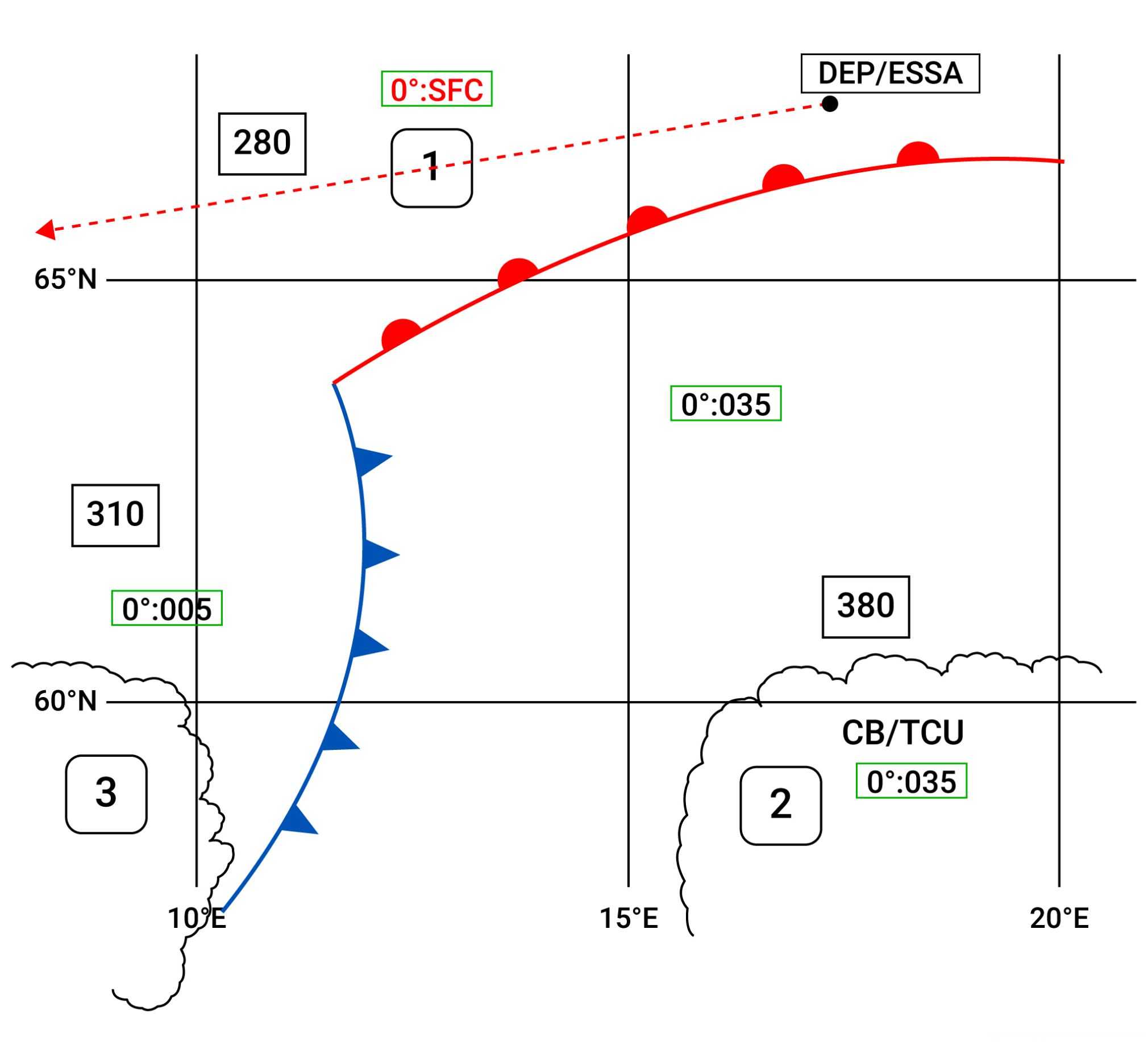
- Position 3
- Position 2
- There is no warm air mass
- Position 1
Mostra la risposta
Position 2
-
Regarding tropical revolving storms in the northern hemisphere, where do we find the most severe weather conditions?
- In the quadrant to the left of the track of the storm
- In the outer spiral rain band
- In the quadrant to the right of the track of the storm
- Within the eye
Mostra la risposta
In the quadrant to the right of the track of the storm
-
Which of the following statements is correct about Monsoons?
- Summer: offshore wind, blowing from the land to the sea. Winter: offshore wind, blowing from the land to the sea.
- Summer: offshore wind, blowing from the land to the sea. Winter: onshore wind, blowing from the sea towards the land.
- Summer: onshore wind, blowing from the sea towards the land. Winter: offshore wind, blowing from the land to the sea.
- Summer: onshore wind, blowing from the sea towards the land. Winter: onshore wind, blowing from the sea towards the land.
Mostra la risposta
Summer: onshore wind, blowing from the sea towards the land. Winter: offshore wind, blowing from the land to the sea.
-
During flight the headwind increases suddenly due to wind shear. What initial effect does that have on true airspeed?
- There will be a sudden temporary increase in true air speed.
- None, since wind only affects ground speed and drift.
- There will be a sudden temporary decrease in true air speed.
- There will only be a gradual increase in true airspeed until equilibrium is established again.
Mostra la risposta
There will be a sudden temporary increase in true air speed.
-
Flight Lisbon to Bordeaux, ETA 1800 UTC. What type of precipitation is forecast on the approach to Bordeaux? TAF LFBD 281400Z 281524 26015KT 9999 SHRA BKN020 TEMPO 1620 26020G30KT 8000 +SHRA BKN015CB PROB30 TSRA=
- Moderate snow showers
- Light drizzle and fog
- Continuous moderate rain
- Heavy rain showers
Mostra la risposta
Heavy rain showers
Come ti prepari con QuizAviation
Studio
Scegli materia e argomenti, rispondi e vedi subito la risposta giusta con la spiegazione.
Simulazione d'esame
Lo stesso numero di domande e lo stesso tempo dell'esame vero, con il risultato alla consegna.
Ripasso degli errori
Le domande sbagliate e quelle segnate tornano in un quiz dedicato, finché non le sai.
Report e progressi
Percentuale per materia, andamento nel tempo e report in PDF da portare in scuola.