ATPL · EASA ECQB
Quiz ATPL 021 Conoscenza generale dell'aeromobile
Conoscenza generale dell'aeromobile: cellula e struttura, comandi di volo, carrello e freni, motore a pistoni o a turbina, carburante e lubrificazione, impianto elettrico, eliche e strumenti di bordo. È la materia del "come funziona": capire il perché di ogni impianto rende più semplici le domande e più sicura la gestione delle avarie in volo.
Argomenti di 021 Conoscenza generale dell'aeromobile
- 021-01 - System Design, Loads, Stresses, Maintenance
- 021-02 - Airframe
- 021-03 - Hydraulics
- 021-04 - Landing Gear, Wheels, Tyres, Brakes
- 021-05 - Flight Controls
- 021-06 - Pneumatics – Pressurisation and Air Conditioning Systems
- 021-07 - Anti-icing and De-icing Systems
- 021-08 - Fuel System
- 021-09 - Electrics
- 021-10 - Piston Engines
- 021-11 - Turbine Engines
- 021-12 - Protection and Detection Systems
- 021-13 - Oxygen Systems
10 domande d'esempio di 021 Conoscenza generale dell'aeromobile
Domande della banca dati EASA ECQB, come le trovi nei quiz gratuiti. Prova a rispondere, poi apri la soluzione.
-
In theory, the fatigue life limit is reached sooner when an aircraft makes, on a daily basis…
- three flights of one hour each.
- one flight of three hours.
- six flights of 30 minutes each.
- two flights of 90 minutes each.
Mostra la risposta
six flights of 30 minutes each.
-
Which of the following can a pilot do to reduce the risk of overloading the airframe?
1. Avoid headwinds
2. Avoid excessive bank angles
3. Avoid turbulence
4. Fly below VA
5. Avoid tailwinds- 1, 2 and 4.
- 1, 3 and 4.
- 2, 3 and 5.
- 2, 3 and 4.
Mostra la risposta
2, 3 and 4.
-
Refer to annex. The hydraulic system that works correctly is shown in:
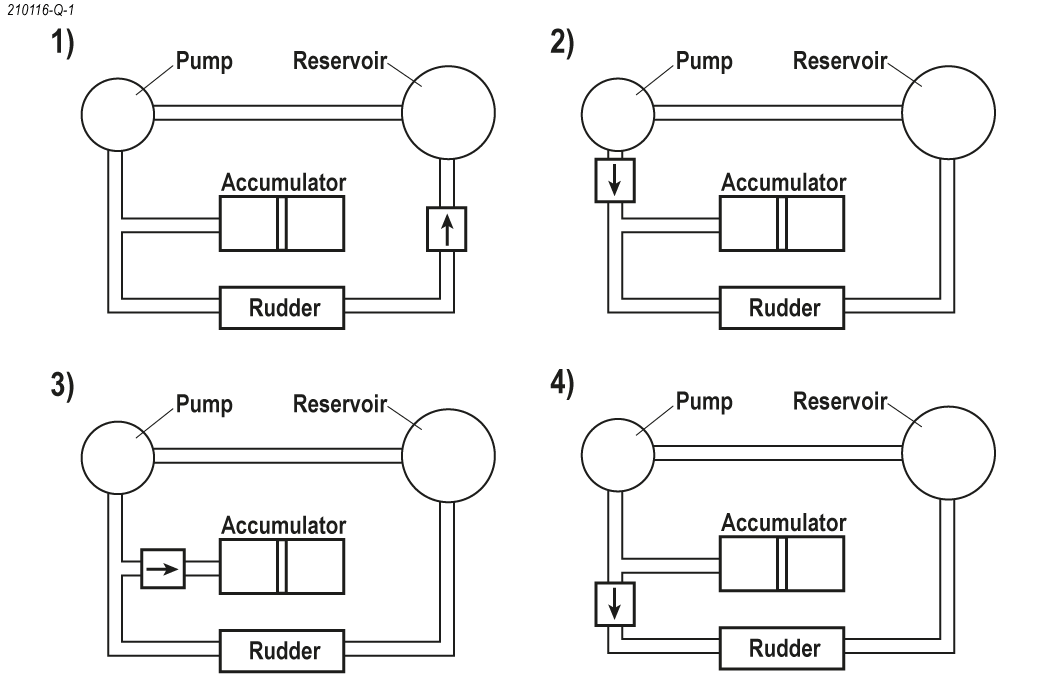
- diagram 2
- diagram 4
- diagram 3
- diagram 1
Mostra la risposta
diagram 2
-
For this question refer to the annex. The number in the annex that shows the retraction actuator is:
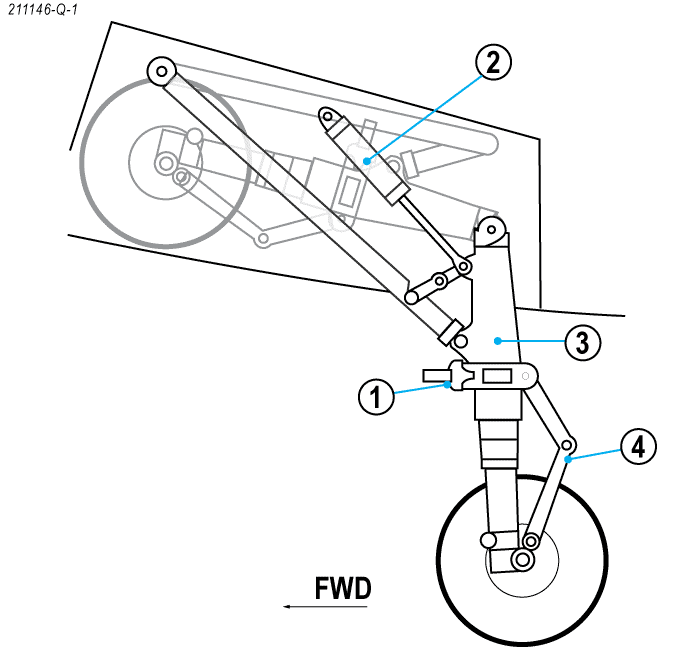
- number 1.
- number 4.
- number 3.
- number 2.
Mostra la risposta
number 2.
-
For most large aeroplanes, spoilers are…
- lower wing surface devices and their deflection is always asymmetrical.
- upper wing surface devices and their deflection is always asymmetrical.
- lower wing surface devices and their deflection can be either symmetrical or asymmetrical.
- upper wing surface devices and their deflection can be either symmetrical or asymmetrical.
Mostra la risposta
upper wing surface devices and their deflection can be either symmetrical or asymmetrical.
-
A medium transport jet is cruising at FL380 when a failure occurs in the bleed air system, causing the cabin altitude to decrease. The pilots follow the appropriate checklists and isolate the failure, but the cabin altitude continues to decrease. What is the appropriate course of action?
- Initiate a descent to prevent exceeding the maximum differential pressure.
- Maintain the current altitude and monitor the situation.
- Initiate a climb to prevent exceeding the maximum differential pressure.
- Manually deploy the passenger oxygen masks.
Mostra la risposta
Initiate a descent to prevent exceeding the maximum differential pressure.
-
A primary ice detection system can be defined as a system that…
- only detects ice accretion on the primary flight control surfaces.
- only provides an advisory annunciation of the presence of ice accretion or icing conditions.
- cannot be used to activate the ice protection systems.
- can be relied upon as the sole means of detecting ice accretion or icing conditions.
Mostra la risposta
can be relied upon as the sole means of detecting ice accretion or icing conditions.
-
Why are additives added to Jet A fuel?
- To prevent the fuel from forming any ice within
- To kill any bacteria
- To make the fuel more stable
- To make the fuel more economical
Mostra la risposta
To prevent the fuel from forming any ice within
-
In a multi-cell lithium battery, one cell sets on fire. Which of the following is likely to happen?
- The fire will spread to other cells within the battery.
- The pilot will be able to stop the fire manually.
- The casing around the battery will prevent the fire damaging the other cells.
- The fire will be contained within the battery by the casing, so no danger exists.
Mostra la risposta
The fire will spread to other cells within the battery.
-
Given the following statements about diesel engines:
1. power is set by the mixture control
2. there is no mixture control
3. the amount of power is determined by the fuel flow only
4. thermal efficiency is higher than that for a petrol engine
5. diesel fuel is more inflammable than petrolThe combination that regroups all of the correct statements is…
- 2, 4, 5.
- 1, 3, 5.
- 2, 3, 4.
- 1, 2, 3.
Mostra la risposta
2, 3, 4.
Come ti prepari con QuizAviation
Studio
Scegli materia e argomenti, rispondi e vedi subito la risposta giusta con la spiegazione.
Simulazione d'esame
Lo stesso numero di domande e lo stesso tempo dell'esame vero, con il risultato alla consegna.
Ripasso degli errori
Le domande sbagliate e quelle segnate tornano in un quiz dedicato, finché non le sai.
Report e progressi
Percentuale per materia, andamento nel tempo e report in PDF da portare in scuola.