ATPL · EASA ECQB
ATPL 032 - Performance quiz
Performance: take-off, climb, cruise, descent and landing, with the charts and tables of the manuals, required and available distances, and the effects of mass, altitude, temperature, wind and runway. Many questions start from a chart, and the only way to read charts quickly is to work through a lot of them.
032 - Performance topics
- 032-01 - General
- 032-02 - C2-23/Applicable Operational Requirements Performance Class B - Theory
- 032-03 - CS-23/Applicable Operational Requirements Performance Class B – Use of Aeroplane Performance Data for Single- and Multi-engine Aeroplanes
- 032-04 - CS-25/Applicable Operational Requirements Performance Class A – Theory
- 032-05 - CS-25/Applicable Operational Requirements Performance Class A – Use of Aeroplane Performance Data
10 sample 032 - Performance questions
Questions from the EASA ECQB question bank, as you find them in the free quizzes. Try to answer, then open the solution.
-
For a jet aircraft, which of these statements is true regarding best range with altitude?
- Best range decreases steadily with altitude.
- Best range increases steadily with altitude.
- Best range increases up to an optimum altitude, then decreases after that.
- Best range is achieved at lower altitudes.
Show the answer
Best range increases up to an optimum altitude, then decreases after that.
-
Which of the following regroups the set of conditions which lead to an increase in take-off distance?
- Downhill slope; low QNH; wet runway
- Downhill slope; high QNH; contaminated runway
- Uphill slope; low pressure altitude; contaminated runway
- Uphill slope; high pressure altitude; wet runway
Show the answer
Uphill slope; high pressure altitude; wet runway
-
Refer to figure or CAP 697 file 2.2.1.
ISA + 20ºC
Given the following information, determine the fuel flow and TAS:
Pressure altitude: 2 500 ft
Manifold pressure: 25.0 In.Hg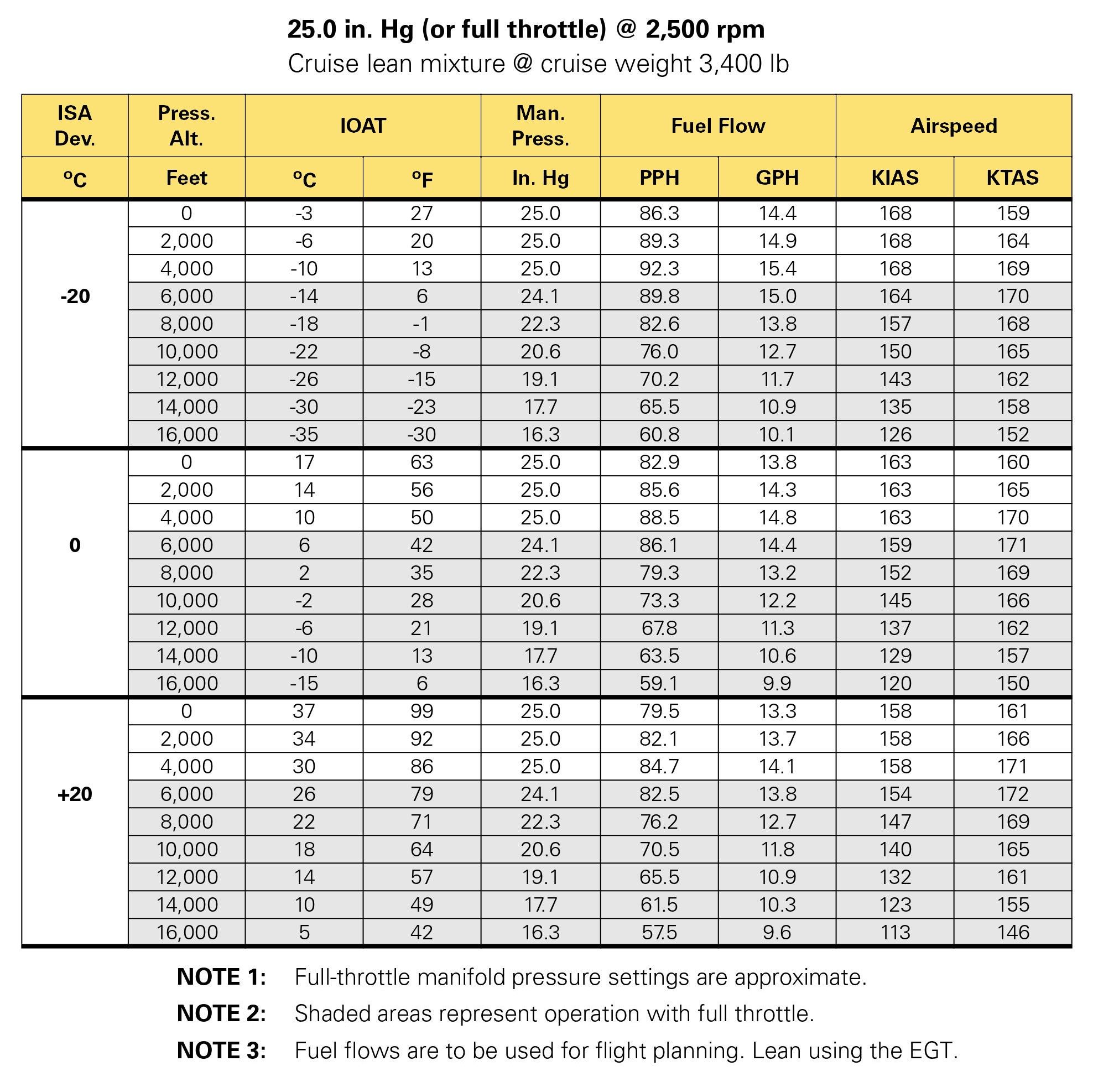
- 13.8 gallons per hour and 167 KTAS.
- 14.0 gallons per hour and 170 KTAS.
- 14.1 gallons per hour and 171 KTAS.
- 13.7 gallons per hour and 166 KTAS.
Show the answer
13.8 gallons per hour and 167 KTAS.
-
Which of the following statements accurately describes the Long Range Cruise (LRC) speed, when compared to the maximum range speed?
- It is more fuel-efficient.
- It has a higher angle of attack.
- It corresponds to a higher Cost Index (CI).
- A longer flight time is required to cover a given distance.
Show the answer
It corresponds to a higher Cost Index (CI).
-
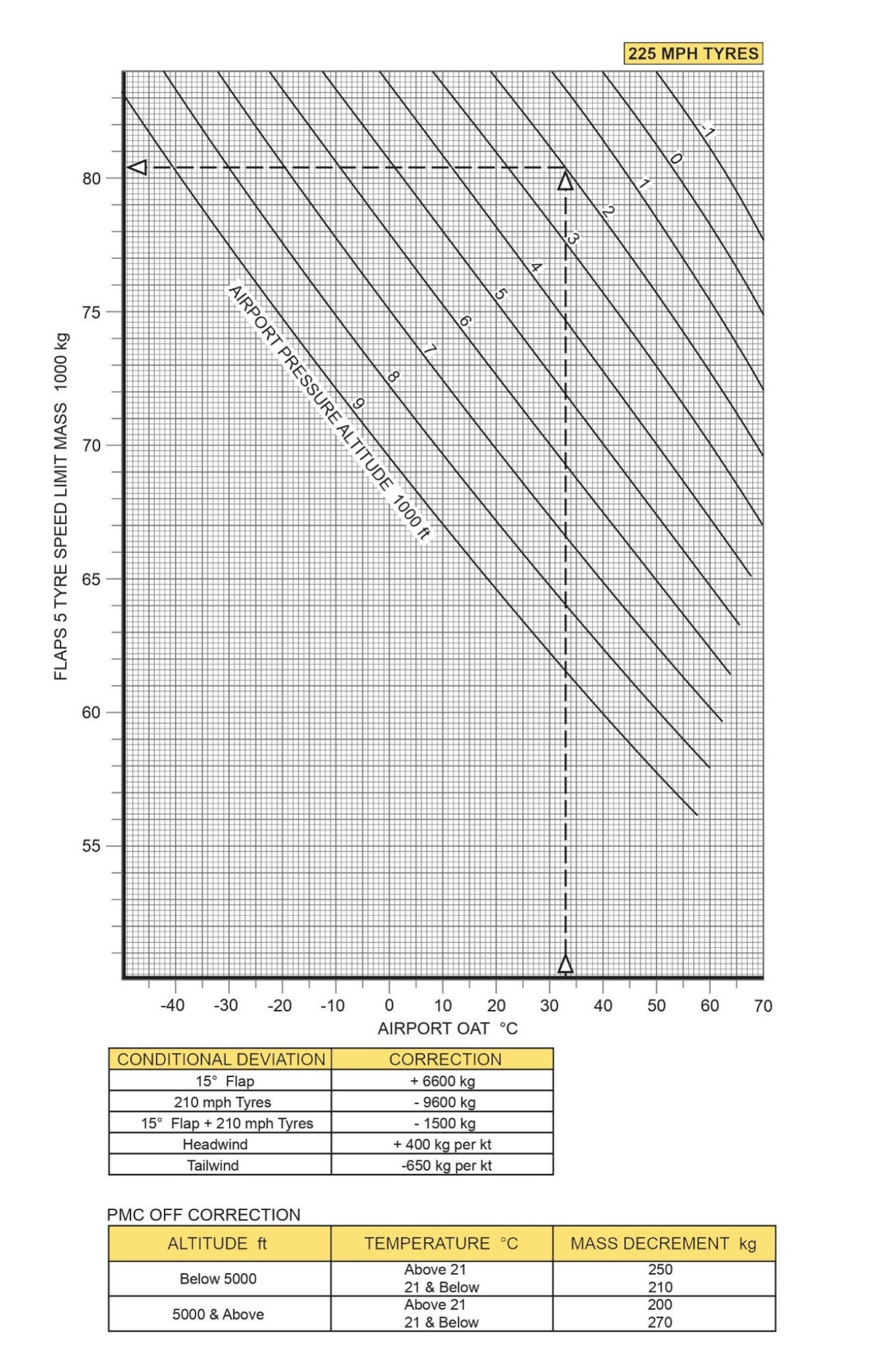
Refer to figure or CAP 698 file 4.6.
Given the following information:- Outside air temperature: 25°C
- Pressure altitude: 7 000 ft
- Tailwind component: 3 kt
- Flaps: 5°
- PMC: OFF
Find the FLAPS 5 TYRE SPEED LIMIT MASS for an aircraft which is fitted with 210 mph tyres.
- 73 050 kg
- 56 850 kg
- 57 900 kg
- 59 450 kg
Show the answer
56 850 kg
-
Refer to figure.
Assuming a constant L/D ratio, which of the diagrams provided correctly shows the movement of the "Thrust Required Curve". Mass m1 is higher than mass m2.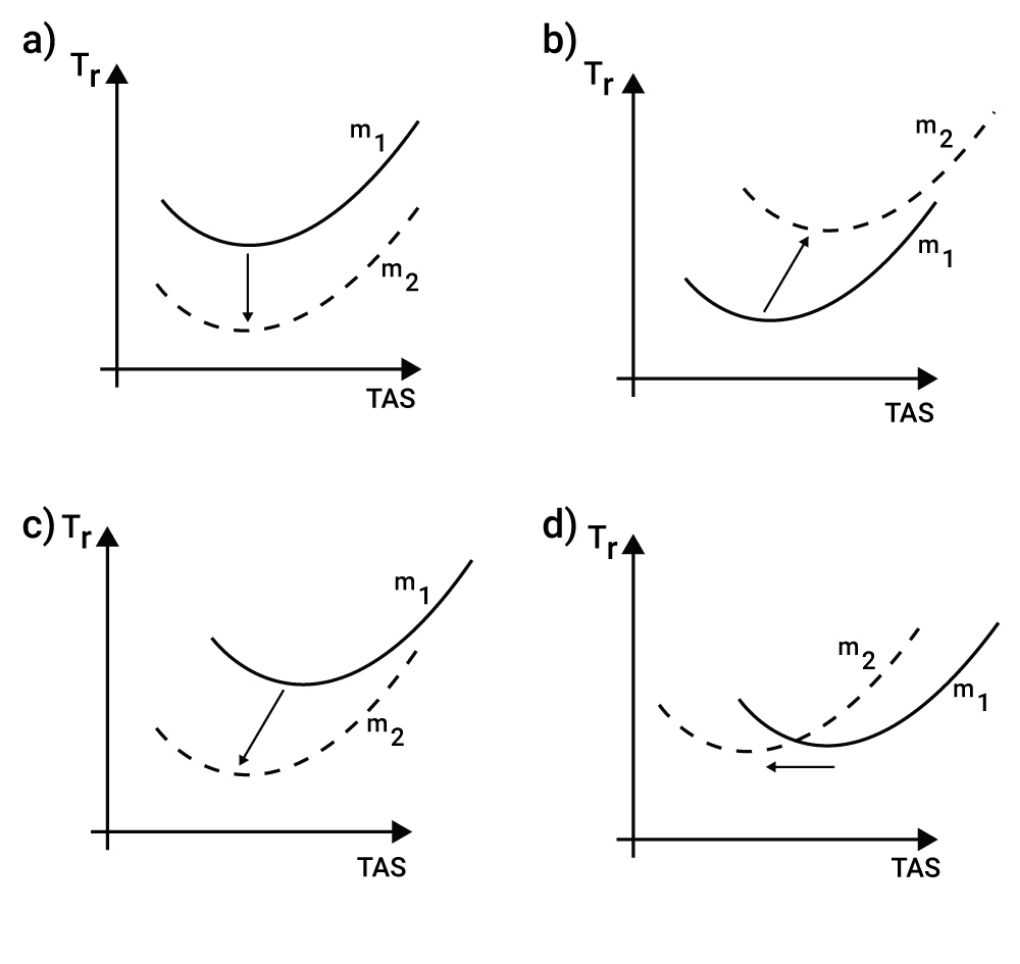
- Diagram c
- Diagram b
- Diagram a
- Diagram d
Show the answer
Diagram c
-
If a Performance Class B multi-engined aeroplane experiences an engine failure after lift-off, the initial effect will be…
- rolling due to lift vector asymmetry between the wings.
- pitch-down due to the loss of elevator effectiveness.
- pitch-up due to total lift decrease.
- yawing due to thrust line asymmetry.
Show the answer
yawing due to thrust line asymmetry.
-
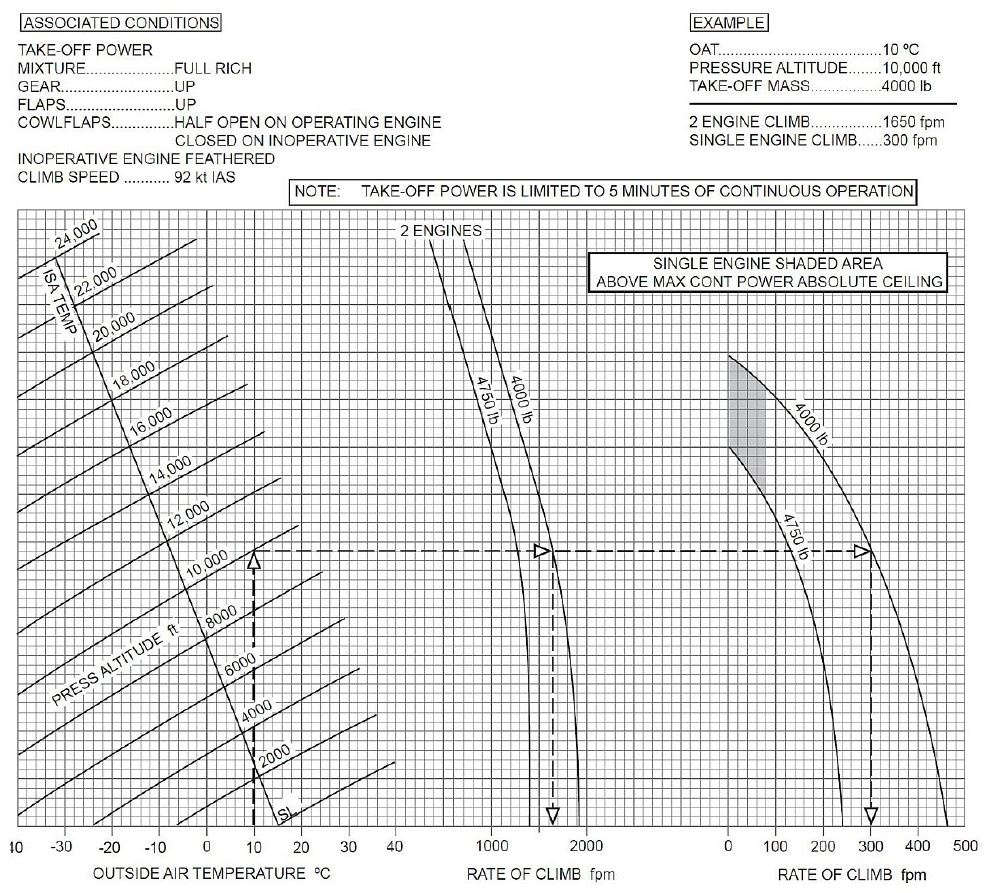
Please refer to the annex or to CAP 698 Figure 3.6. Given the following information, determine the all-engine still-air gradient. Take-Off Mass: 4000 lb Airport elevation: 5000 ft OAT: ISA Headwind: 10 kt Climb speed: 92 kt IAS, 99 kt TAS Flaps: Up Gear: Up Power: Take-off
- 14%
- 4%
- 21%
- 19%
Show the answer
19%
-
What is the effect of a tailwind on the descent angle and flight path angle?
- Descent angle increases, flight path angle increases.
- Descent angle remains constant, flight path angle increases.
- Descent angle decreases, flight path angle decreases.
- Descent angle remains constant, flight path angle decreases.
Show the answer
Descent angle remains constant, flight path angle decreases.
-
Please refer to the annex or to CAP 698 Figure 4.29. Given the following information, what is the Climb-Limited Landing Mass?
- OAT +10° C
- Pressure Altitude 2000 ft
- Flap Position 30°
- A/C Packs AUTO
- ENGINE & WING Anti-ice ON
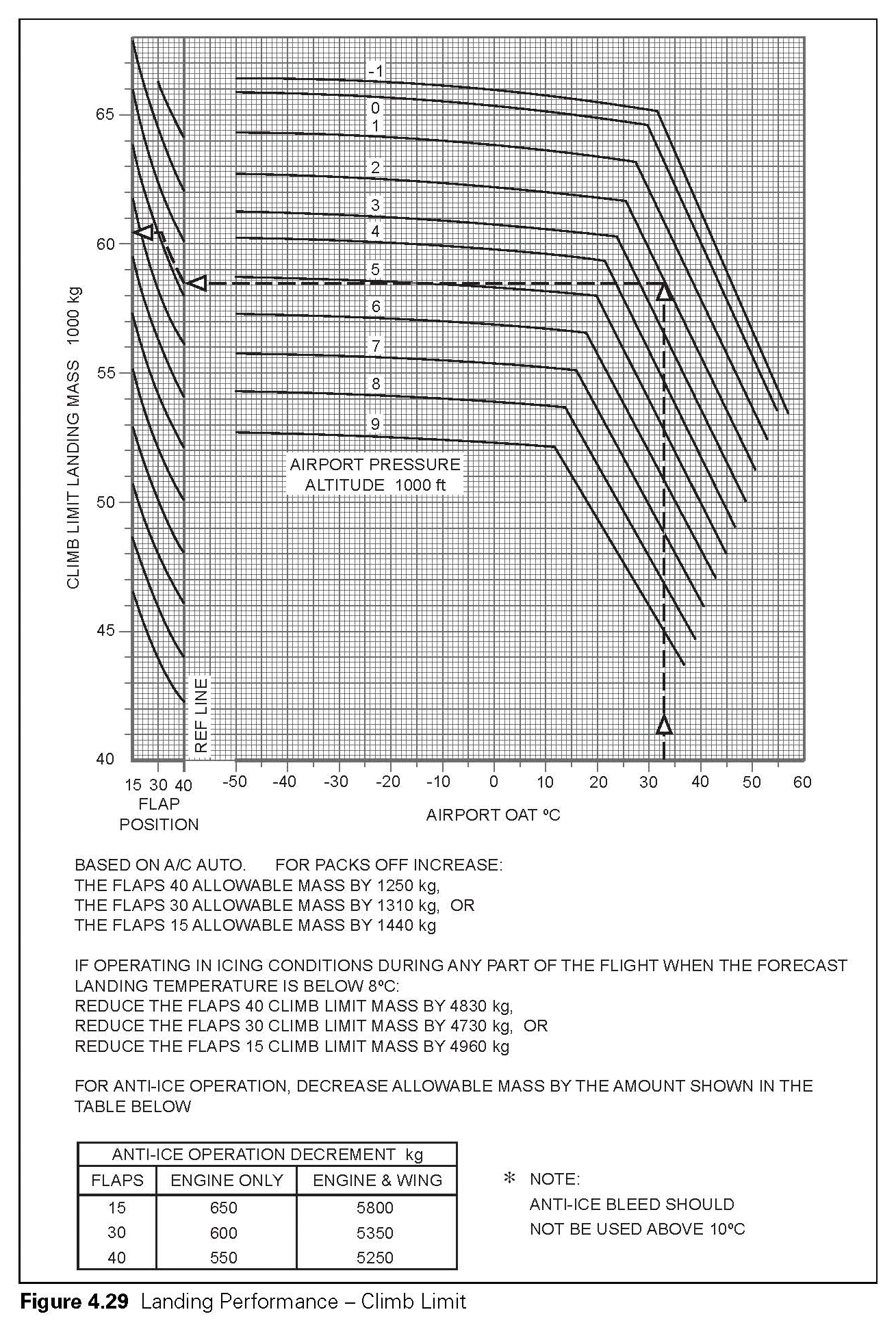
- 54 380 kg
- 64 400 kg
- 69 750 kg
- 59 050 kg
Show the answer
59 050 kg
How you prepare with QuizAviation
Study
Pick a subject and its topics, answer and see the right answer with its explanation right away.
Mock exam
The same number of questions and the same time as the real exam, with the result when you hand it in.
Review your mistakes
Wrong and flagged questions come back in a dedicated quiz until you know them.
Reports and progress
Score by subject, trend over time and PDF reports to share with your school.