ATPL · EASA ECQB
ATPL 031 - Mass and Balance quiz
Mass and balance: mass definitions, structural limits, centre of gravity and arm, MAC, loading of passengers, baggage and fuel, load tables and loadsheets. It is a calculation subject: practise the numerical questions until they become automatic, because time matters in the exam.
031 - Mass and Balance topics
- 031-01 - Purpose of Mass and Balance Considerations
- 031-02 - Loading
- 031-04 - Mass and Balance Details of Aircraft
- 031-05 - Determination of CG Position
- 031-06 - Cargo Handling
10 sample 031 - Mass and Balance questions
Questions from the EASA ECQB question bank, as you find them in the free quizzes. Try to answer, then open the solution.
-
Prior to departure an aircraft is loaded with 16 500 litres of fuel at a fuel density of 780 kg/m3. This is entered into the load sheet as 16 500 kg and calculations are carried out accordingly. As a result of this error, the aircraft is…
- lighter than anticipated and the calculated safety speeds will be too low.
- heavier than anticipated and the calculated safety speeds will be too low.
- heavier than anticipated and the calculated safety speeds will be too high.
- lighter than anticipated and the calculated safety speeds will be too high.
Show the answer
lighter than anticipated and the calculated safety speeds will be too high.
-
Refer to figure.
Consider a flight with a twin-jet-engined aeroplane WITHOUT the Additional Centre Tank (ACT). Determine the maximum total mass of fuel that can be loaded into the Outer and Inner Tanks.
For this flight, the fuel density given by the fuel supplier is 0.80 kg/l.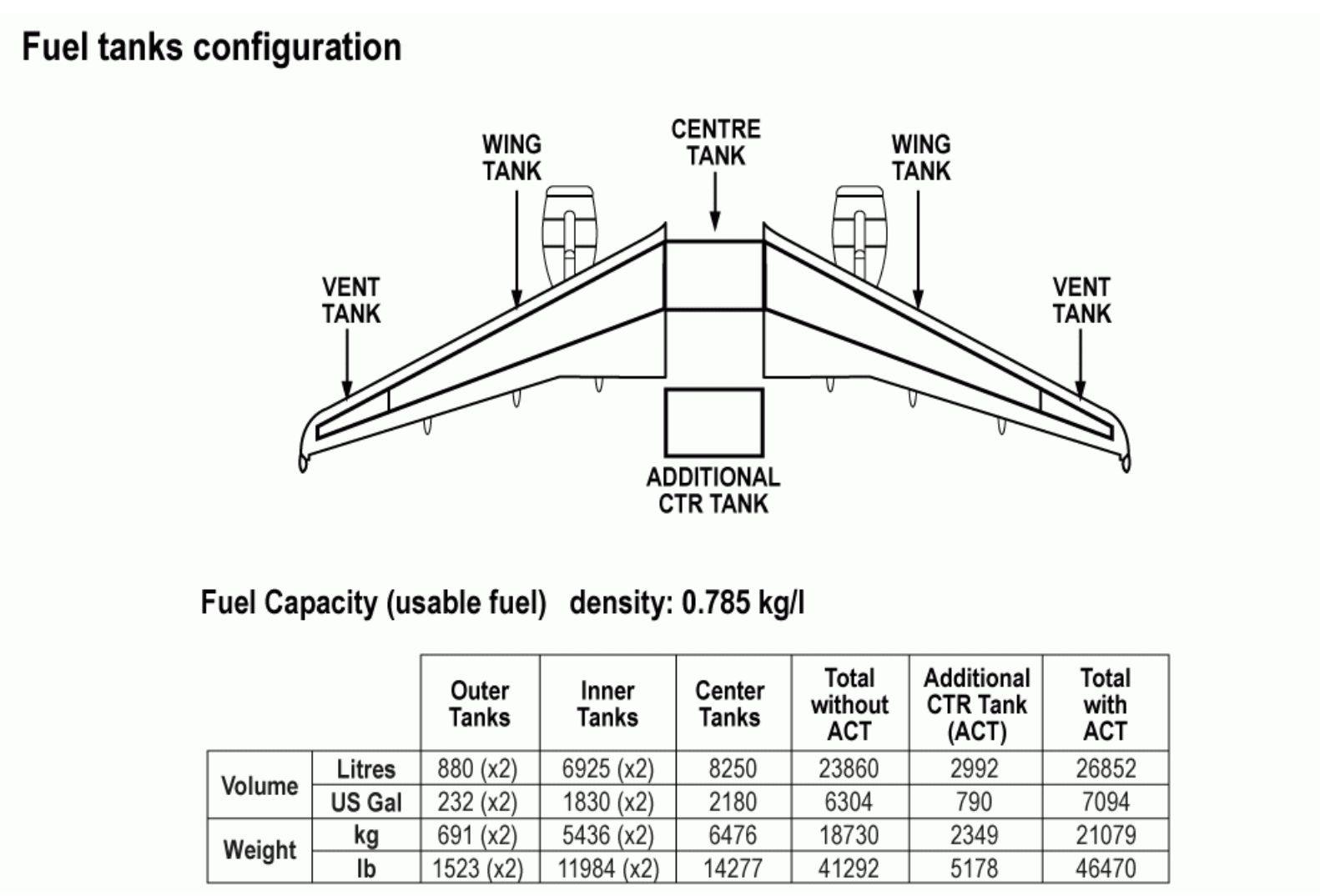
- 6244 kg
- 12 254 kg
- 12 488 kg
- 19 513 kg
Show the answer
12 488 kg
-
Given the following information, calculate the centre of gravity of a jet as %MAC...
MAC Leading edge: 13.21 m aft of datum
MAC Trailing edge: 15.63 m aft of datumWeighing of aircraft:
Tail jack: 3345.25 kg
Right main wheel: 19 720.57 kg
Left main wheel: 19 730.69 kgLocations:
Center of gravity: 13.65 m aft of datum
Tail jack: 21.34 m aft of datum
Nose jack: 4.22 m aft of datum
Main wheels: 16.98 m aft of datum- 25.7% MAC.
- 18.2% MAC.
- 112.5% MAC (CG is behind MAC).
- Not enough data to calculate the CG position.
Show the answer
18.2% MAC.
-
On large Commercial Air Transport aeroplanes, prior to every flight, the Operator uses the trim sheet in electronic or paper format to determine the CGs of the actual Zero Fuel Mass, Take-Off Mass and Landing Mass. This is...
- done by computing the balance arm of the actual operational masses and the results are given in metres or inches.
- done by referring to the stations of various fuselage sections defined in mass and balance documentation.
- to ensure that the CGs are within the certified envelope, and is achieved by using the index method.
- to check that they are below the limits published in the Aircraft Flight Manual, and is achieved by calculating the moments.
Show the answer
to ensure that the CGs are within the certified envelope, and is achieved by using the index method.
-
Refer to figure or CAP696 Figure 4.9.
For the forward cargo compartment (Cargo Hold 1), area between balance arms (BA) 286 in and 343 in, determine which of the 4 crates may be loaded: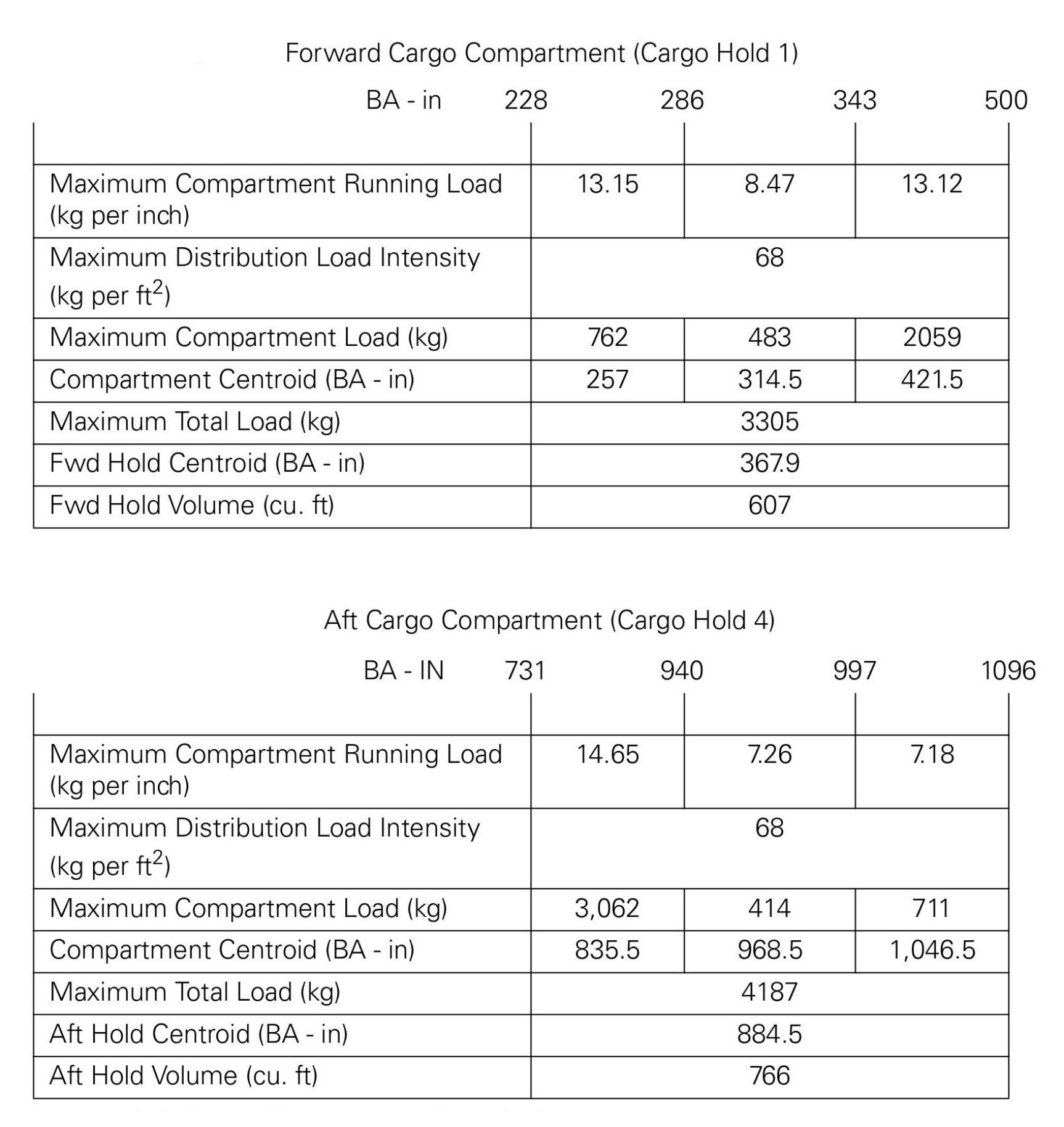
- Crate Z: 6.56 kg/inch and 69 kg per ft2
- Crate Y: 8.45 kg/inch and 67 kg per ft2
- Crate X: 8.56 kg/inch and 70 kg per ft2
- Crate W: 8.30 kg/inch and 90 kg per ft2
Show the answer
Crate Y: 8.45 kg/inch and 67 kg per ft2
-
Which CG position is used when determining minimum control speeds in performance? A CG…
- at the forward limit.
- at the average position.
- at the aft limit.
- mid of the aft and forward limits.
Show the answer
at the aft limit.
-
5600 USG is equivalent to…
- 466 Imp Gal
- 4663 Imp Gal
- 633 Imp Gal
- 4366 Imp Gal
Show the answer
4663 Imp Gal
-
The Basic Empty Mass (BEM) and the Basic Empty Mass Centre of Gravity (CG) position are noted in…
- The load and trim sheet.
- The weighing report.
- The cargo manifest.
- The certificate of airworthiness.
Show the answer
The weighing report.
-
Refer to figure.
According to the diagrams indicating the CG position %MAC of four different aircraft, what is the most stable aircraft?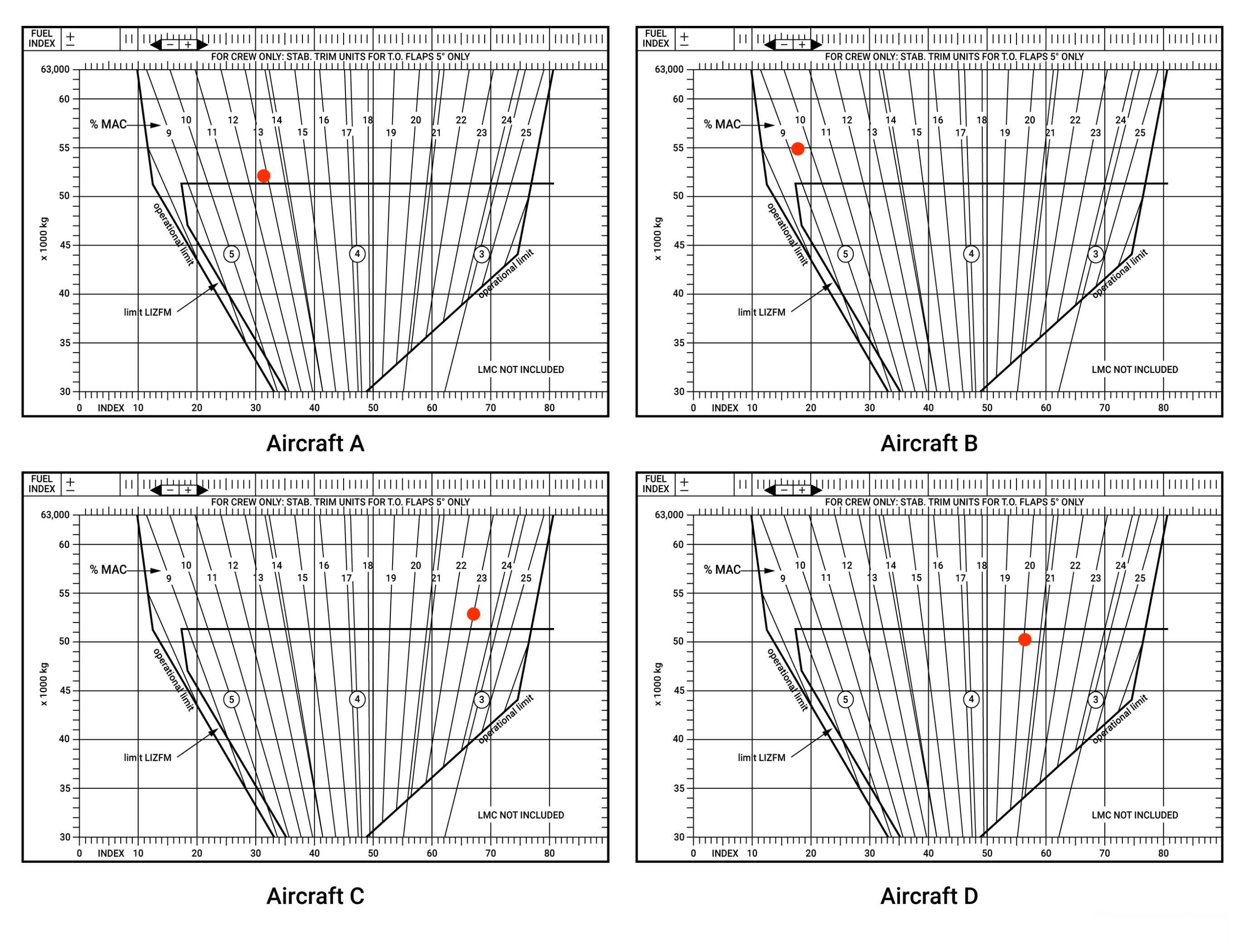
- Aircraft B.
- Aircraft D.
- Aircraft A.
- Aircraft C.
Show the answer
Aircraft B.
-
Loads must be adequately secured in order to:
- prevent excessive ‘g’-loading during the landing flare.
- avoid unplanned centre of gravity (cg) movement and aircraft damage.
- allow steep turns.
- avoid any centre of gravity (cg) movement during flight.
Show the answer
avoid unplanned centre of gravity (cg) movement and aircraft damage.
How you prepare with QuizAviation
Study
Pick a subject and its topics, answer and see the right answer with its explanation right away.
Mock exam
The same number of questions and the same time as the real exam, with the result when you hand it in.
Review your mistakes
Wrong and flagged questions come back in a dedicated quiz until you know them.
Reports and progress
Score by subject, trend over time and PDF reports to share with your school.